


Beyond the Numbers: How Appreciation Shapes Our Financial Choices
November Planning & Perspective
What does financial success really look like?
For some, it’s reaching a retirement savings goal. For others, it’s having the flexibility to spend more time with family, pursue meaningful experiences, give generously, or simply feel more prepared for whatever comes next.
Author James Clear offers an interesting perspective:
“Your calendar is a better measure of success than your bank account.” — James Clear |
The thought is simple, but important.
Savings, investments, and financial milestones matter. But the way we choose to use our time and financial resources can reveal something equally important: what we value most.
Even the Consumer Financial Protection Bureau takes a broader view of financial well-being. Rather than defining it by income or net worth alone, the CFPB considers factors such as having control over everyday finances, being able to absorb a financial shock, staying on track toward financial goals, and having the freedom to make choices that allow you to enjoy life.
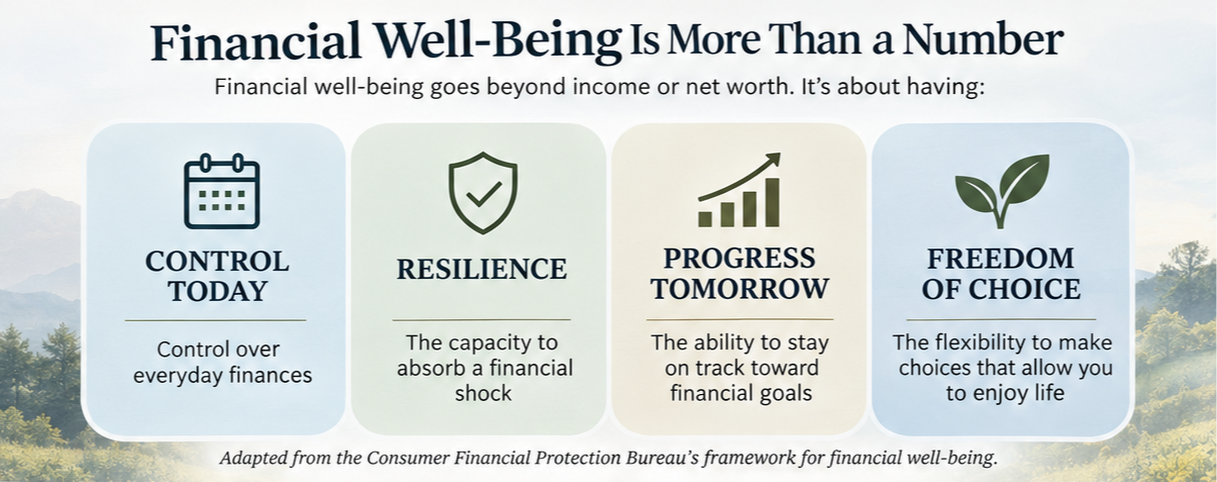
Financial well-being isn’t simply about accumulating more. It’s about creating greater financial confidence, choice, and possibility.
As November brings a natural season of gratitude and reflection, it offers an opportunity to ask a different kind of financial question:
Are the resources we have being directed toward the things we value most?
Appreciation Can Clarify Your Financial Priorities
Every financial goal has a purpose behind it.
Retirement savings may represent future freedom. An education fund may represent opportunity for the next generation. Emergency savings may represent greater financial confidence when life doesn’t go according to plan. Travel savings may represent time and experiences with the people you love. Charitable giving may represent the desire to contribute to something beyond yourself.
That connection between financial resources and personal priorities is an important part of thoughtful financial planning.
The financial planning process itself considers more than numbers. Personal circumstances, values, goals, needs, priorities, timelines, and financial resources all help shape the decisions that follow.
The numbers matter. But they become more meaningful when there is clarity around what those numbers are intended to accomplish.
Gratitude can help bring that clarity into focus. It can help us recognize what already feels abundant, distinguish between what we genuinely value and what we simply feel pressure to pursue, and identify where additional financial resources could create the most meaningful impact.
A Question Worth Asking
If you had greater financial margin today, where would you most want it to go?
Toward greater security? More retirement savings? Time with family? Travel or meaningful experiences? Supporting children or grandchildren? Giving more generously?
The answer may reveal something important about the priorities your financial plan should be supporting.
Every Financial “Yes” Has a Trade-Off
Resources are finite, which means nearly every financial decision involves a trade-off.
Economists call this opportunity cost: the value of the next-best alternative we give up when choosing one option over another.
If additional income goes toward a major purchase, those dollars can’t simultaneously increase retirement savings. If more is directed toward long-term investing, it may mean postponing a vacation or another near-term goal. If a family chooses to increase charitable giving, that decision becomes part of the larger conversation around cash flow, savings, taxes, and future priorities.
There isn’t always one universally “right” answer. The important question is whether the trade-off is intentional.
Appreciation can provide a useful lens here. When we understand what matters most, it becomes easier to decide what deserves a “yes,” what can wait, and where our resources may create the greatest value.
A Budget Is More Than a Spending Limit
This is where budgeting becomes especially useful.
A thoughtful budget isn’t simply a record of where money went last month. It’s a plan for where available resources should go next.
It can help bring together essential expenses, emergency reserves, debt obligations, retirement and investment contributions, short- and long-term goals, charitable giving, and discretionary spending.
Viewed this way, a budget is less about restriction and more about allocation.
It answers a practical question:
How can the resources available today support both the life I’m living and the future I’m building?
That distinction matters because financial planning isn’t always about spending less.
Often, it’s about spending, saving, investing, and giving more intentionally.
Preparing for the Unexpected While Planning for the Future
Intentionality also means recognizing that not every financial priority can be planned perfectly.
Unexpected expenses arise. Long-term goals compete with current needs. And building financial confidence and clarity often requires preparing for both at the same time.
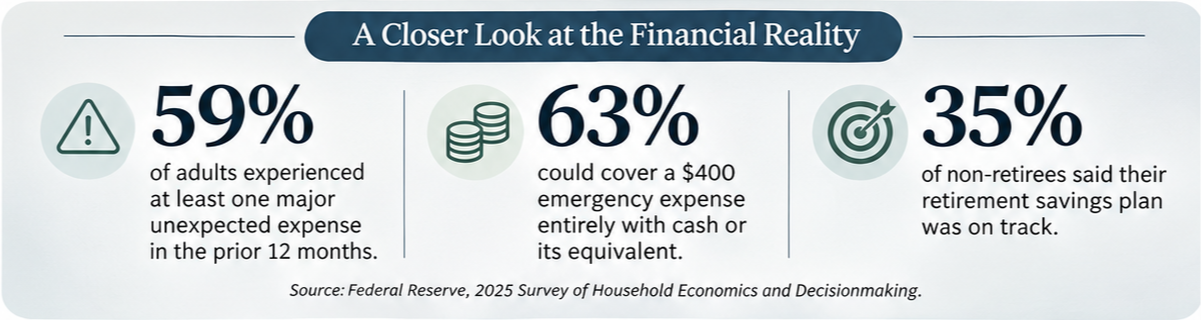
We are preparing for tomorrow while still needing the flexibility to handle today.
Emergency reserves, retirement contributions, insurance, investments, and thoughtful cash-flow planning serve different purposes, but they work together toward the same broader goal: creating greater resilience and greater choice over time.
Turning Appreciation Into Intentional Giving
Gratitude can also shape the way we think about generosity.
For some, that may mean regular charitable contributions. For others, it may involve helping family members, supporting a local organization, or developing a longer-term giving strategy.
Charitable giving can also become part of a broader financial and tax-planning conversation.
Depending on individual circumstances, strategies such as donor-advised funds, qualified charitable distributions, gifts of appreciated assets, or planned giving may provide different ways to support meaningful causes while considering tax circumstances and long-term financial goals.
The appropriate strategy depends on factors such as age, income, assets, tax situation, charitable intentions, and the broader financial plan.
But the starting point doesn’t necessarily have to be a particular strategy. It can begin with a simpler question:
What has mattered enough in my life that I want to help make it possible for someone else?
That’s where gratitude can move from something we feel to something we intentionally act upon.
Balancing Today’s Priorities With Tomorrow’s Goals
Good financial planning requires looking ahead.
Retirement contributions matter. Emergency reserves matter. Investment strategy matters. Tax planning matters.
But preparing for the future doesn’t require ignoring the present.
The experiences we hope to have, the people we want to support, and the opportunities available to us today matter too.
A thoughtful financial plan seeks to balance both.
That could mean maintaining consistent retirement contributions while intentionally budgeting for family travel. It could mean strengthening emergency savings before increasing discretionary spending. It could mean adjusting a savings strategy after a major life change. Or it could simply mean recognizing that a goal that mattered five years ago may no longer carry the same importance today.
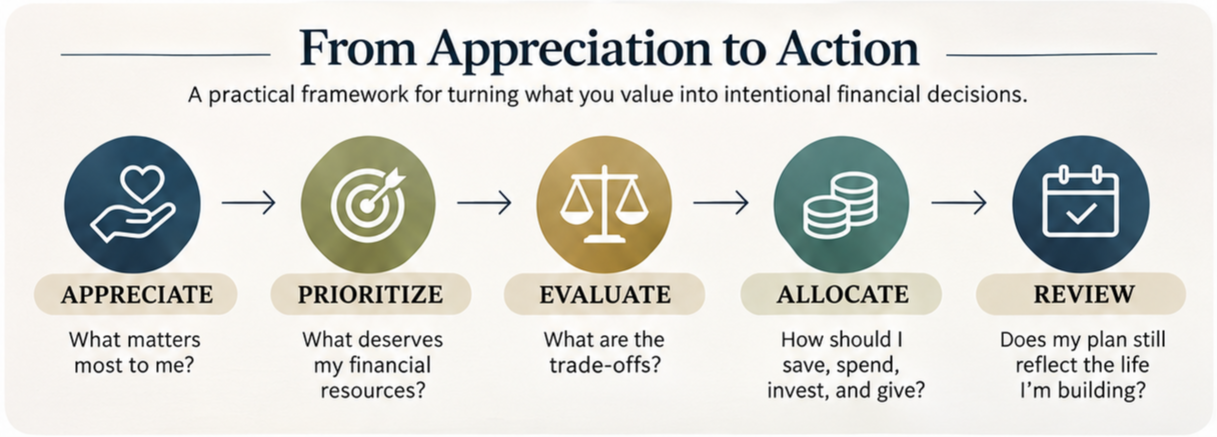
Financial plans should evolve because life evolves.
Your November Financial Check-In
As the year begins to wind down, consider three questions:
1. Are my financial goals still aligned with what matters most to me?
2. Am I balancing today’s priorities with long-term savings, investing, and financial security?
3. What is one financial decision I could approach more intentionally before the end of the year?
The answers don’t necessarily require an immediate change. But they can begin a worthwhile conversation.
Because every financial decision is, in some way, a decision about priorities.
Appreciation helps us see those priorities more clearly. Planning helps us put resources behind them.
Beyond the Numbers
Financial success can’t always be captured by a single account balance, rate of return, or milestone.
It can also be reflected in the emergency you were prepared to handle. The retirement you had the discipline to prepare for. The experience you were able to share with your family. The person you were able to help. The opportunity you were able to say yes to.
Because the true value of money isn’t simply what we accumulate. It’s what we make possible with it.
As we reflect on what we’re grateful for this season, perhaps one of the most meaningful financial questions we can ask isn’t simply, “How much have I accumulated?”
What is my financial plan making possible?
Sources & References
Consumer Financial Protection Bureau, “Financial Well-Being.” View source
Board of Governors of the Federal Reserve System, Report on the Economic Well-Being of U.S. Households in 2025, published May 2026. View source
CFP Board, Code of Ethics and Standards of Conduct. View source
James Clear, “Your calendar is a better measure of success than your bank account.” View source
This article is intended for educational purposes and does not constitute individualized financial, tax, or legal advice. Individual circumstances vary.